
Hot Water System Running Costs Australia 2024 | Bill Hero
How Much Does a Hot Water System Cost to Run? Your hot water system quietly works away, heating water whenever
The AER's new 'Game Changer Reforms' to protect vulnerable retail energy consumers are a welcome step, but they do not go far enough.

The Australian Energy Regulator (AER) has announced a new package of 'Game Changer Reforms' intended to better protect vulnerable energy consumers. Their strategy, Towards Energy Equity – A Strategy for an Inclusive Energy Market, outlines a set of so-called 'Game Changer Reforms' designed to achieve systemic changes and better outcomes for energy consumers experiencing vulnerability.
In collaboration with various stakeholders, the AER has developed a comprehensive package of solutions to rebalance costs and risks within the energy sector.
These reforms were presented at the Energy and Climate Change Ministerial Council (ECMC) meeting on 24 November 2023.
The energy sector, being vital to everyday life, should be inclusive for all consumers. However, vulnerable consumers have historically faced poor outcomes, exacerbated by rising cost-of-living pressures.
In 2022, the AER identified $645 million in annual financial costs related to retail energy vulnerability, 57% of which are borne by energy consumers, alongside additional non-quantifiable impacts such as negative impacts to health and wellbeing.
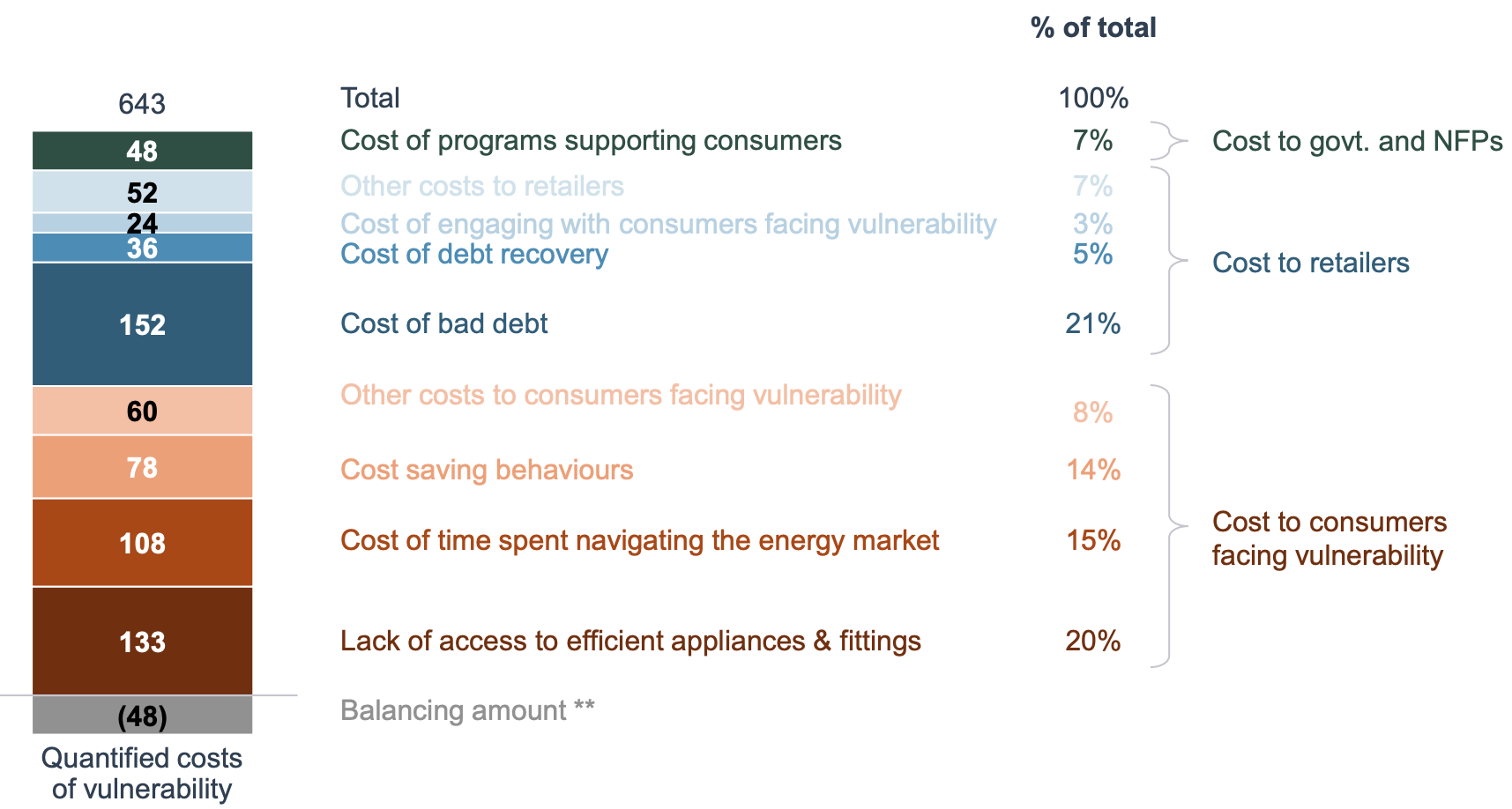
The new strategy includes four key elements:
The trickiest element of the strategy to implement will be the proposed co-funding scheme for retailers' costs in managing and supporting vulnerable energy consumers.
Retailer costs of bad debts, debt recovery, and vulnerable customer engagement programs are estimated at $231.5m pa, so the retailers will jump at any opportunity to offload some of those costs onto the public purse.
The strategy includes a mitigation for this:
... retailers would only be able to access ... funds where they have demonstrated that they have provided best practice support to the consumers. By tying access to co-funding to a demonstration of best-practice customer support, retailers will be incentivised to optimise their support practices for all consumers, not just those who may become eligible for debt relief.
The existence of a co-funding scheme presents a natural incentive for energy retailers to transfer customers with significant debt into hardship programs simply to access co-funding for debt relief.
These measures, coupled with existing government initiatives and the National Energy Transformation Partnership, are claimed to provide a holistic approach to addressing energy hardship.
Taken together, these proposed measures provide a comprehensive and novel approach to addressing energy hardship. They complement existing government initiatives, retain retailers’ relationships with their customers, and align with the National Energy Transformation Partnership established by Ministers in 2022. [Bill Hero emphasis]
The strategy is based on the flawed notion that energy consumers actually have a 'relationship' with their retailer that is meaningful and worth protecting, and that retailers actually value the 'relationships' they have with their vulnerable customers. As such, the reforms lock energy consumers into a relationship with their current retailer, no matter how (un)competitive their prices may be.
While these reforms are welcome in principle, they fall short of what is required to truly assist vulnerable energy consumers - which is to help them find and switch to the best-priced plans available from any retailer, not just from their current retailer, and to ensure that the new retailer they're trying to switch to cannot reject their applications on the basis they are a concession holder or a potentially vulnerable customer.
In addition to this, a true reform should ensure that no matter when or how often concession-eligible energy consumers might switch, their concession entitlements are seamlessly transferred to the new retailer.
The AER's 'Game Changer' reforms represent a significant shift towards a more inclusive and supportive energy market. These reforms can potentially create a fairer, more equitable retail energy sector, but they do not go far enough to help protect vulnerable energy consumers and ensure the best possible outcomes for them.

In welcome news for energy consumers, default offer prices are falling for the first time in years.

Retail energy prices in regional QLD will increase 28% from 1 July

Australia's energy regulator is taking a closer look at virtual power plants as big retailers snap up smaller operators. Here's what the ACCC's scrutiny means for your energy choices.

Energy prices are up, so let's check the rules on when, how often, and by how much retailers can increase their prices. Here's everything you need to know.
Savings as a Service is the newsletter from Bill Hero. Subscribe now and get your energy savings tips and information delivered fresh to your inbox every month.